

Your tank has a green fog, or hair algae threading through your plants, or black beard algae stubbornly coating the driftwood. It looks like a disaster, but algae is really just telling you this: there are more nutrients in the water than the current ecosystem can process, and enough light to let algae capitalize on it.
This guide focuses on root-cause fixes that rebalance the tank, not quick coverups. Different algae types respond to different interventions, so we’ll start with identifying what you’re actually fighting. Most algae problems clear within three to four weeks once you address light, feeding, and nutrient management consistently.
What you’ll need
Tools:
- Aquarium test kit (nitrate and phosphate tests both recommended)
- Timer for aquarium light
- Algae scraper or magnetic cleaner
- Siphon and bucket for water changes
Materials:
- Dechlorinated water for water changes
- Optional: phosphate test kit for tap water (~$15)
- Optional: algae eater fish or snails (with major caveats — see Step 5)
Prerequisites:
- A cycled tank with established beneficial bacteria
- Ability to do weekly water changes
Before you start
Algae is a symptom, not the disease. It blooms when excess nutrients — from overfeeding, fish waste, decaying plant matter, or even your tap water — meet sufficient light. Scraping it off without addressing the nutrient source means it returns in two weeks.
Avoid chemical algae killers as a first resort. Copper-based treatments and algaecides can kill invertebrates, harm beneficial bacteria, and stress fish. They also do nothing to fix the conditions that caused the bloom.
Do not overstock algae eater fish. Adding three plecos to handle algae means you’ve added three fish worth of waste, often worsening the problem instead of solving it.
Step 1: Identify your algae type
Not all algae respond to the same treatment. The type growing in your tank points to which nutrient is out of balance.
Green water (suspended algae, cloudy green water column):
- Cause: High nitrates relative to phosphates, excess light
- Responds to: Light reduction, water changes, possible blackout period
Hair algae / thread algae (long stringy strands on plants and décor):
- Cause: High phosphates relative to nitrates, inconsistent maintenance
- Responds to: Phosphate reduction, manual removal, improved water flow
Black beard algae / black brush algae (dark tufts on slow-growing plants, equipment, glass edges):
- Cause: Low CO₂, low water flow in specific areas, organic buildup
- Responds to: Increased flow, manual removal, addressing dead zones
Brown algae / diatoms (brown dusty film on surfaces, common in new tanks):
- Cause: Silicates in tap water, low light, new tank cycling
- Responds to: Time (often resolves as tank matures), manual removal, snails
Green spot algae (hard green dots on glass and slow-growing plant leaves):
- Cause: Low phosphates, high light
- Responds to: Increasing phosphates slightly (or accepting it as cosmetic)
Knowing your algae type helps you target the intervention. Most home tanks deal with hair algae or green water, both driven by nutrient imbalance rather than equipment failure.
Step 2: Reduce light exposure to 8-10 hours daily
Excess light fuels all algae types. Even indirect window light or running your aquarium light 12+ hours daily gives algae an advantage over plants and beneficial bacteria.
Set your light on a timer for 8-10 hours in a single uninterrupted block. Consistency matters more than duration — algae thrives when light schedules are erratic.
If your tank is near a window, block indirect sunlight during peak hours with a backdrop or curtain.
What success looks like: Algae growth slows within a week. You won’t see immediate die-off, but new growth tapers.
Step 3: Cut back feeding
Overfeeding is the single largest contributor to excess nitrogen and phosphates. Uneaten food decays, releasing nutrients directly into the water column. Even food that gets eaten produces waste.
Feed once daily, only as much as your fish consume within two minutes. If food sinks to the substrate uneaten, you’re feeding too much.
Skip one feeding day per week. Fish are cold-blooded and handle fasting well — a weekly break gives your biological filter time to catch up on accumulated waste.
What success looks like: No visible food waste after feeding. Water clarity improves between water changes.
Step 4: Test and manage nutrient levels (the critical step)
This is where precision replaces guesswork. Algae thrives on nutrient imbalance, and testing lets you see which nutrient is driving the problem.
Test your display tank water
Use your test kit to measure nitrates and phosphates. According to aquatic management research, the ratio between nitrogen and phosphorus matters as much as the absolute levels (University of Florida IFAS Extension):
- High nitrates (>20 ppm), low phosphates (<0.5 ppm): Favors green water algae
- Low nitrates (<10 ppm), high phosphates (>1 ppm): Favors hair algae and thread algae
- Both elevated: Favors mixed algae blooms
Target range for planted tanks: nitrates 10-20 ppm, phosphates 0.5-1 ppm. For fish-only tanks, keep nitrates below 20 ppm and phosphates below 1 ppm.
Test your tap water
Many municipal water systems add phosphates as a corrosion inhibitor for pipes. If your display tank shows high phosphates despite regular water changes, your tap water may be the hidden source.
Actionable step: Test your tap water with a phosphate kit before using it for water changes. If phosphates measure above 0.5 ppm:
- Use phosphate-removing resin in your filter
- Pre-treat replacement water with a phosphate binder
- Switch to RO (reverse osmosis) water for water changes, remineralizing as needed
This single intervention solves persistent algae for many fishkeepers who were unknowingly adding phosphates with every water change.
Balance nutrients rather than eliminating them
Plants need both nitrogen and phosphorus. Starving the tank of all nutrients often leads to plant die-off, which then decays and releases nutrients back into the water — restarting the algae cycle.
If you have live plants and testing shows imbalanced nutrients, consider dosing the lower nutrient slightly to restore ratio, rather than just reducing the higher one. This stabilizes the system faster. Consult aquatic plant resources for dosing guidance (Cornell Cooperative Extension provides regionally specific aquaculture management information).
What success looks like: Nutrient levels stabilize within target ranges. Algae growth slows significantly within two weeks as the imbalance corrects.
Step 5: Increase water change frequency to 25-50% weekly
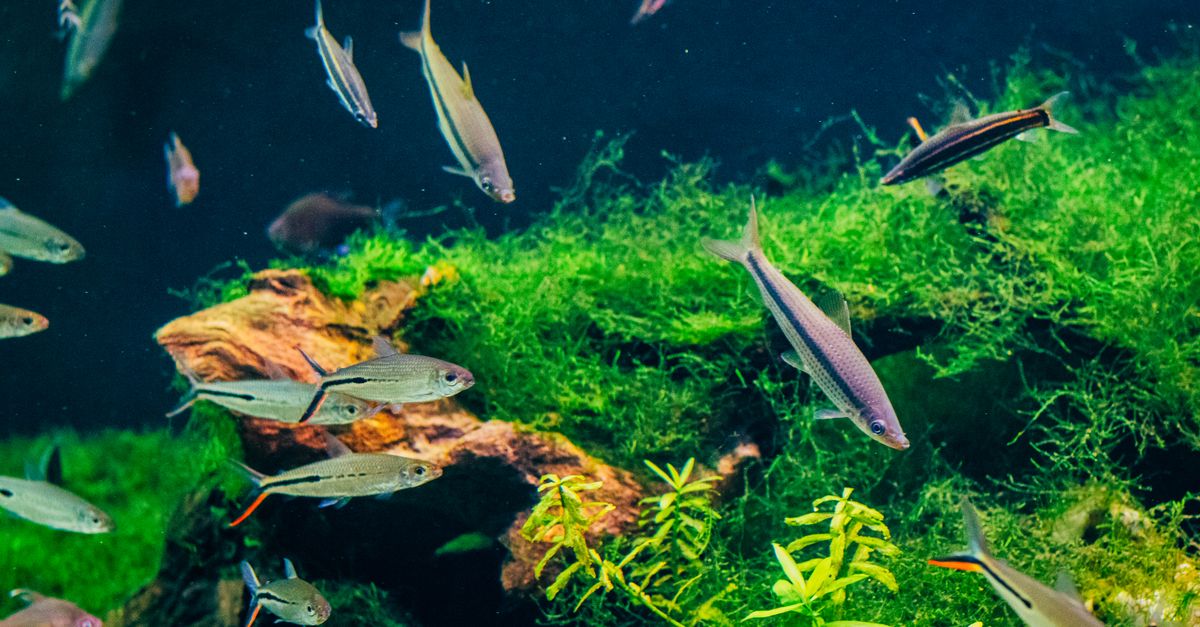
Water changes physically remove dissolved nutrients before algae can use them. This is your most reliable long-term control.
Use a siphon to vacuum the substrate while draining, targeting waste accumulation zones: under decorations, around plant roots, in low-flow corners. Replace with dechlorinated water matched to tank temperature.
If you currently do 25% every two weeks, shift to 25% weekly. For active algae problems, increase to 50% weekly until it’s under control, then maintain at 25-30% weekly.
Use pre-tested or treated water if your tap water has high phosphates (see Step 4).
What success looks like: Water is visibly clearer. Existing algae browns and begins detaching within two to three weeks as nutrient availability drops.
Step 6: Consider algae eater fish — with realistic expectations
Algae eaters are limited biological controls, not cures. They eat specific algae types and many reduce algae-eating once other food is available.
Species and limitations:
-
Otocinclus catfish: Small (2 inches), peaceful, effective on soft green algae and diatoms. Best in groups of six. Needs a mature tank with established algae to graze.
-
Siamese algae eater (SAE): Eats hair algae and black beard algae as a juvenile but becomes less effective as it matures and grows to 6 inches. Active swimmer, needs 55+ gallon tank long-term.
-
Nerite snails: Eat diatoms and soft algae. Won’t eat hair or thread algae. Don’t reproduce in freshwater, so population stays controlled. Sturdy choice for beginners.
-
Amano shrimp: Graze on hair algae and soft algae. Peaceful, active. Need stable water parameters and won’t tolerate copper-based medications.
-
Common plecos: Grow to 12-24 inches. Produce significant waste, often uproot plants, and largely stop eating algae as adults. Not recommended unless you have a pond or 100+ gallon tank for their full lifespan.
Do not add algae-eating livestock unless your water parameters are stable (Steps 1-5 completed) and you can house them properly long-term. These animals deserve real care, not single-purpose placement.
What success looks like: Algae eaters graze on existing algae but don’t solve the nutrient problem. Steps 1-5 remain essential.
Step 7: Manually remove stubborn algae

For algae on glass, decorations, or equipment, manual removal speeds results.
Use an algae scraper or magnetic cleaner on glass weekly. For hair algae on plants, gently twist it off by hand or trim affected leaves. Rinse decorations in old tank water, never tap water (which kills beneficial bacteria).
Remove algae from the tank entirely — don’t let it break apart and resettle. Siphon debris during water changes.
For black beard algae, spot-treat with a small amount of 3% hydrogen peroxide on a cotton swab (turn off filter, dab affected areas, wait 5 minutes, turn filter back on). This weakens the algae for easier removal. Use sparingly.
What success looks like: Visible algae is gone. Continued nutrient management (Steps 1-5) prevents regrowth.
Verify it worked
After three to four weeks, check for:
- Water is clearer, no green tint
- New algae growth has slowed or stopped
- Existing algae is browning and detaching (dead algae turns brown or white)
- Nitrate and phosphate levels have stabilized in target ranges
If algae persists, recheck light duration, feeding quantity, water change frequency, and tap water quality. Those four factors control the vast majority of algae problems.
Troubleshooting
Problem: Algae came back after initial improvement
You’ve treated the symptom but not the root cause. Double-check: Are you overfeeding? Has light crept past 10 hours? Did you skip water changes? Is your tap water adding phosphates? Algae returns when conditions favor it again.
Problem: Algae eater isn’t eating algae
Many species ignore algae if other food is abundant. Cut back supplemental feeding. Also confirm the algae type matches the species — plecos don’t eat hair algae, nerite snails don’t eat black beard algae.
Problem: Green water (suspended algae) won’t clear
Green water is phytoplankton and doesn’t respond to scraping. Try a three-day blackout: cover the tank completely, turn off all lights, run the filter. After three days, resume 8-hour lighting and increase water changes to 50% twice weekly until it clears. UV sterilizers also work for green water if blackout fails.
Problem: Algae only grows in one area
Uneven water flow creates dead zones where waste accumulates. Adjust filter output or add a small circulation pump to improve flow across the entire tank. Black beard algae especially thrives in low-flow spots.
Problem: Algae grows on slow-growing plants but not fast-growing ones
Fast-growing plants outcompete algae for nutrients. Slow-growing plants (Anubias, Java fern) are algae magnets when nutrient levels are high. This confirms nutrients are the issue — focus on Steps 3-5.
When to consult an aquatics specialist
If algae persists after six weeks of consistent light reduction, feeding restraint, weekly 50% water changes, and tap water testing, something deeper may be wrong:
- Tap water with unusually high baseline phosphates or nitrates requiring RO system
- Failed biological filter (ammonia or nitrite present, indicating cycle crash)
- Chronic overstocking (too many fish for tank size and filtration capacity)
Research from the American Fisheries Society on aquatic ecosystem management (fisheries.org) and published aquaculture studies (PubMed Central) emphasize that persistent algae in closed systems signals ecosystem imbalance requiring professional assessment. An aquatics veterinarian or experienced aquarium specialist can test for hidden nutrient sources and recommend equipment upgrades if needed.
Don’t resort to repeated chemical treatments until you’ve ruled out water quality issues and nutrient imbalance.
FAQ
What causes different types of algae?
Algae type depends on which nutrient is oversupplied. High nitrogen relative to phosphorus tends to produce green water. High phosphorus relative to nitrogen favors hair algae. Black beard algae grows in low-flow areas with organic buildup. All types need light and nutrients, but the specific imbalance determines which algae dominates.
Can I completely eliminate algae from my tank?
No, and you shouldn’t want to. Small amounts of algae are normal in a healthy tank and even beneficial — they consume nitrates and provide grazing surfaces for some fish and invertebrates. The goal is control, not eradication. A light film on surfaces or minor algae presence is fine. Problems start when algae covers more than half your surfaces or clouds the water.
Do algae eaters really control algae?
Algae eaters help with existing algae but don’t fix the root nutrient problem. Many species stop eating algae once other food is available, and large species like common plecos produce waste that can worsen algae long-term. They’re tools, not standalone solutions. Steps 1-5 remain essential.
How often should I clean my tank to prevent algae?
Weekly 25-30% water changes are the foundation. Glass can be scraped weekly or as needed. Avoid over-cleaning — daily water changes or constant scrubbing disrupts beneficial bacteria and can destabilize the tank, sometimes making algae worse.
Should I use chemicals to kill algae?
Only as a last resort after addressing nutrients, light, and water quality for at least six weeks. Chemical algaecides kill algae but release all their stored nutrients back into the water as they decompose, often triggering a second bloom. They also risk harming fish, invertebrates, and beneficial bacteria. Fix the ecosystem balance first.
Why does my tap water matter for algae?
Some municipal water has phosphates added to prevent pipe corrosion. If your tap water contains phosphates above 0.5 ppm, every water change adds fuel for algae. Testing your tap water separately and pre-treating it or switching to RO water can solve algae problems that don’t respond to other interventions.
Algae isn’t a failure — it’s your tank giving you information about its current balance. Most algae clears once you address the underlying nutrient ratio, reduce light to reasonable levels, and stop overfeeding. Those three changes, maintained consistently for a month, solve the majority of algae problems without equipment upgrades or livestock additions. The algae that remains after that tends to be cosmetic rather than systemic, the kind you scrape off glass weekly and otherwise ignore.