
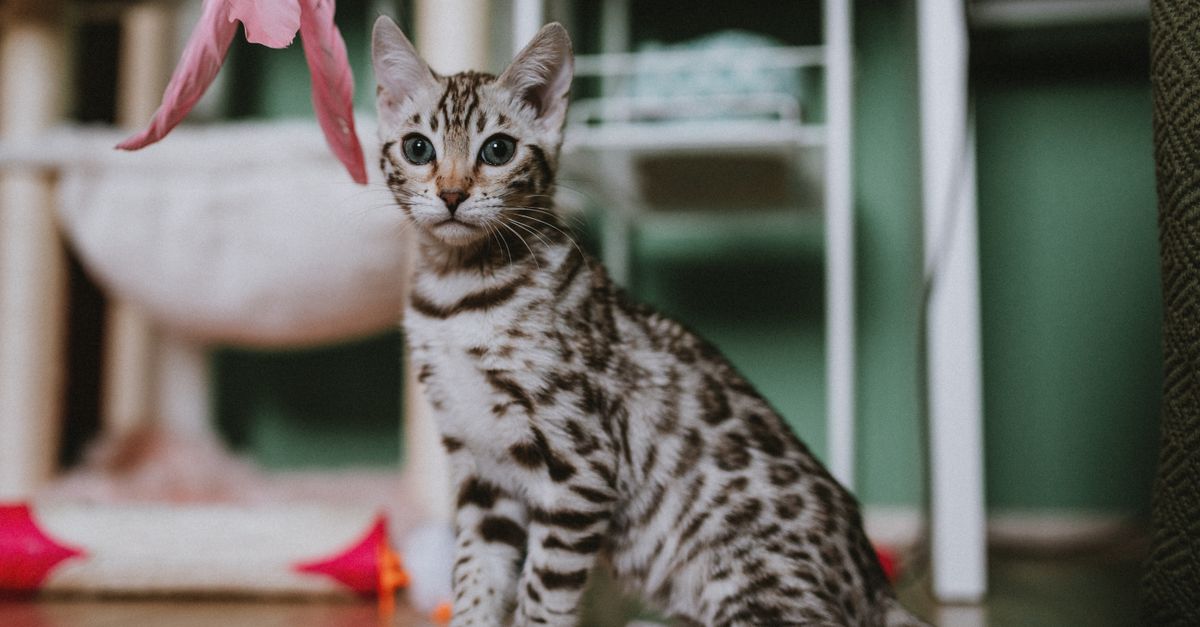
Indoor cats are small predators stuck in a living room. They’re built to hunt, stalk, and problem-solve their way through 10–15 small prey catches a day, and instead they get a bowl of kibble and a couch. Without enrichment toys that mimic those natural behaviors, they get bored—and boredom in cats shows up as behavior problems veterinarians see constantly: destructive scratching, litter box avoidance, aggression toward housemates, and stress-related overeating.
Environmental enrichment is a welfare standard, not a luxury. The ASPCA and AVMA both identify it as essential to feline behavior health. This guide covers enrichment toys by what they do—the type of stimulation they provide and the behavior problems they prevent—not just which ones look good in product photos.
What enrichment actually means (and why it’s not just “fun toys”)
Enrichment lets cats express natural behaviors they’d use outdoors: hunting, climbing, problem-solving, territorial exploration, tactile investigation. Outdoor cats get all of this by default. Indoor cats get none of it unless you build it in.
The three cats in my apartment have very different enrichment preferences—one lives for vertical climbing, one wants puzzle feeders, the youngest will chase anything that moves—but all three need multiple types of stimulation or they redirect that energy into things I don’t want them doing. A single favorite toy isn’t enough. Novelty wears off in 30–60 days, which is why toy rotation matters as much as the toys themselves.
Types of enrichment toys and what behavior problems they prevent
Not all enrichment does the same thing. Here’s how to think about categories:
| Enrichment Type | What It Mimics | Behavior Problems It Prevents |
|---|---|---|
| Hunting/chasing toys | Stalking, pouncing, capturing prey | Destructive play on hands/feet, nighttime zoomies, aggression toward other pets |
| Puzzle toys & feeders | Problem-solving to access food (like working for prey) | Stress-eating, fast eating/vomiting, boredom during the day when you’re gone |
| Climbing structures | Vertical territory, elevated observation posts | Furniture scratching, territorial stress in multi-cat homes, lack of safe retreat space |
| Tactile/texture toys | Investigating prey textures (feathers, fur), satisfying bite/claw contact | Destructive chewing, inappropriate scratching |
Indoor cat boredom prevention comes from covering multiple categories, not buying 10 versions of the same type. If your cat has feather wands but no puzzle toys and no climbing access, you’re only addressing one need.
Puzzle toys and cognitive enrichment: why they work
Most listicles mention puzzle feeders in passing. They shouldn’t. Research published in the Journal of Feline Medicine and Surgery shows that puzzle feeders reduce stress-related overeating, slow consumption (which prevents vomiting), and engage the same problem-solving cats would use hunting.
Cats are not lazy. They’re hunters who’ve been given no problems to solve. Cat puzzle toys fix that.
Starter puzzle feeders
If your cat has never used one, start simple. A ball with holes that dispenses kibble as it rolls is intuitive—they bat it, food falls out, they learn the connection in under a minute. The middle-aged cat here refused to engage with anything puzzle-related until I started with a basic treat ball. Now he’ll work a three-tier puzzle for 10 minutes.
Recommended: Doc & Phoebe’s Indoor Hunting Cat Feeder (mimics scattered prey; you hide them), Catit Senses 2.0 Food Tree (beginner difficulty), PetSafe SlimCat (rolling ball dispenser).
Intermediate to advanced
Once they understand the concept, you can increase difficulty. Multi-tier puzzles, sliding compartments, and lick mats all work. The key is that the effort-to-reward ratio stays satisfying—if it’s too hard, they’ll walk away. If it’s too easy, they’ll finish in 30 seconds and it’s no longer enrichment.
Recommended: Trixie Activity Fun Board (multiple puzzle types in one), Nina Ottosson Buggin’ Out (sliding drawers), LickiMat (for wet food; slows eating, satisfies licking/grooming drive).
Puzzle feeders as meal replacement
You don’t need to use them for every meal, but replacing one daily feeding with a puzzle feeder gives a bored indoor cat something to do while you’re gone. It won’t fix every behavior issue, but it addresses the “nothing to do all day” problem that leads to stress eating and destructive outlets.
For more on feeding strategies that double as enrichment, see slow feeders automatic feeders cats.
Hunting and chasing toys: the catch matters

Cats are ambush predators. They need the stalk, the chase, and the catch. This is where most people get laser pointers wrong—they stimulate the chase drive but deny the catch, which leaves cats frustrated. The AVMA notes that incomplete predatory sequences (chase with no capture) can increase stress rather than relieve it.
Better options: toys the cat can actually “kill.” Feather wands, mice they can carry off, small balls they can trap under a paw.
Interactive play toys (you’re involved)
Feather wands and string toys require your participation, which is good—indoor cats need 2–3 play sessions a day, 10–15 minutes each. These are high-engagement, high-energy, and they let you control the “prey” behavior (erratic movement, pauses, the final pounce).
Recommended: GoCat Da Bird (feather wand; extremely high prey-mimicry movement), Cat Dancer (wire with cardboard—cheap, effective, oddly irresistible).
Solo hunting toys
Realistic mice, crinkle balls, small toys they can carry and “kill.” These work best when scattered in different rooms so the cat has to “hunt” for them. One of mine will relocate every solo toy to the water bowl overnight. I don’t know why. It’s her thing.
Recommended: SmartyKat Skitter Critters (catnip mice; realistic size/weight), Bergan Turbo Scratcher (ball in a track + scratching pad—covers multiple needs), spring toys (cheap, satisfying to bat across hard floors).
Climbing and vertical territory: not optional in small spaces
Cats are vertical animals. They feel safer, less territorial stress, and more in control when they have high perches. If you’re in an apartment with multiple cats and no climbing structures, territorial stress is inevitable. For more on the role of scratching and climbing in feline behavior, see cat scratching posts buying guide.
Recommended: Wall-mounted shelves (Catastrophic Creations makes sturdy ones), cat trees with multiple levels (go tall, not wide), window perches (they’ll spend hours there if the view is good).
The senior cat here has arthritis and can’t jump to high perches anymore, but she still needs vertical access—I added a ramp and lower platforms. Climbing isn’t just for young cats.
Rotation strategy: why every toy eventually becomes invisible

Novelty decay is real. A toy that gets obsessive play for two weeks will be completely ignored by week five. This doesn’t mean the toy is bad—it means the cat’s brain no longer registers it as novel.
Rotation schedule that works:
- Keep 3–4 toys accessible at a time (mix types: one hunting, one puzzle, one solo)
- Rotate every 2–3 weeks—box up the current set, bring out previously stored toys
- Introduce one actually-new toy every 4–6 weeks (you don’t need to buy constantly)
The youngest cat here will lose her mind over a toy she ignored a month ago if it’s been out of sight. Rotation makes old toys new again.
When enrichment isn’t working
If you’ve provided multiple enrichment types, rotated toys, and done daily play sessions for 2–3 weeks and you’re still seeing destructive behavior, litter box issues, or aggression, the problem may not be boredom. Medical issues (pain, cognitive dysfunction in senior cats, hyperthyroidism) and environmental stressors (new pet, move, schedule change) all present as behavior changes.
Consult your vet. Enrichment solves boredom and under-stimulation. It doesn’t solve pain, illness, or fear-based behavior.
For broader guidance on exercise and play frequency, see indoor cat exercise playtime.
Toys that look impressive but don’t deliver
Automatic laser toys: Same problem as handheld lasers—no catch satisfaction—plus they’re not interactive, so the cat gets none of the bonding benefit of play with you.
Expensive robotic toys: Some cats love them. Many ignore them after the first day. Start cheap, see what your cat engages with, then consider premium versions.
Single-function cat trees with no height: A 2-foot tall carpeted box is not climbing enrichment. Cats want vertical territory, not a glorified ottoman.
Frequently asked questions
How many toys does an indoor cat actually need?
Enough to cover hunting, problem-solving, climbing, and tactile needs—usually 8–12 toys total, with 3–4 accessible at a time on rotation. Quality and variety matter more than quantity.
Do puzzle toys frustrate cats?
Not if you start at the right difficulty. Cats are natural problem-solvers. If a puzzle toy sits untouched, it’s either too hard (start simpler) or the cat isn’t food-motivated (try play-based enrichment instead).
Can I use cardboard boxes as enrichment?
Yes. Boxes are genuinely enriching—they’re hiding spots, ambush cover, and tactile investigation all in one. A cardboard box will outperform a $50 gadget if the cat finds it novel. Rotate boxes just like toys.
Is catnip necessary for enrichment toys?
No. Some cats are highly responsive to catnip (about 70% genetically react to it), some aren’t. Silvervine is an alternative that works on some catnip-immune cats. Neither is required—engagement comes from prey mimicry, problem-solving, and novelty, not chemical scent response.
Enrichment toys are not about spoiling a cat. They’re about giving an indoor predator something to do that isn’t your furniture, your hands, or stress-eating. Start with variety, rotate regularly, and pay attention to which types your specific cat actually engages with—it’s individual. For more on preventing behavior issues through environmental design, see cat behavior destructive chewing.