
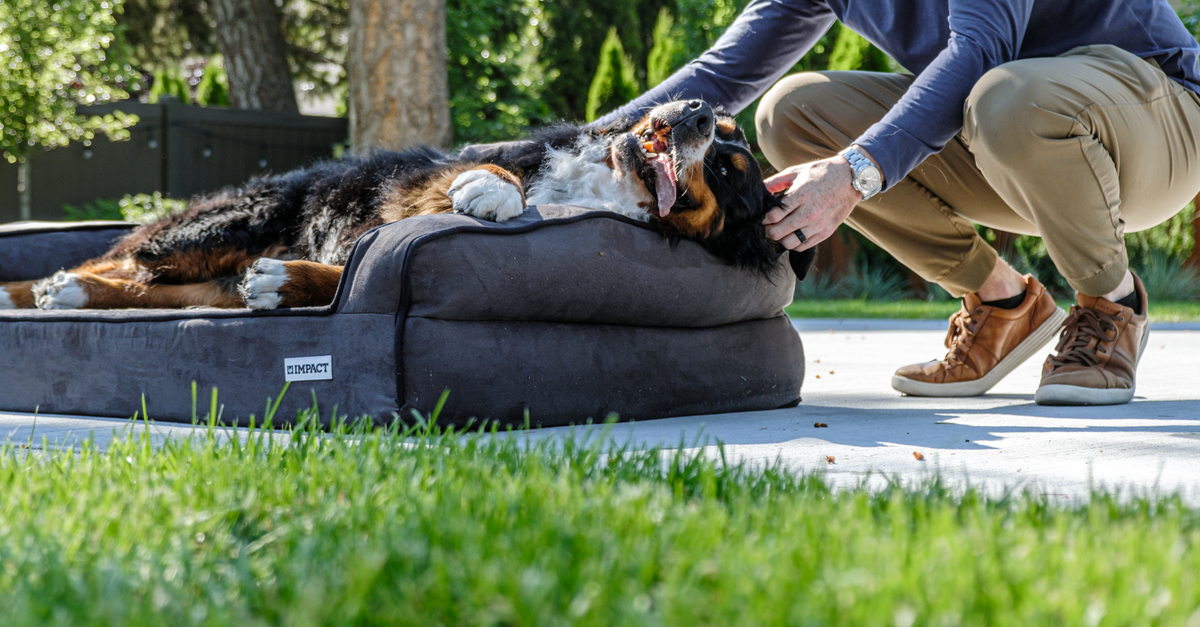
Large dogs experience significantly higher ground reaction forces than smaller breeds during movement—and that same physics problem applies when they’re resting. A 90-pound Lab distributes weight onto hip, elbow, and shoulder joints during sleep, creating pressure hotspots that cheap beds can’t relieve. The result: disrupted REM cycles, morning stiffness, and accelerated joint wear over years.
I’ve fostered more than forty dogs, including half a dozen German Shepherds and Lab mixes over 80 pounds. The difference a properly engineered bed makes isn’t subtle—it’s the difference between a dog who takes ten minutes to stand up in the morning and one who springs up ready to go.
Quick verdict:
- High-density orthopedic foam beds (5+ PCF) are best for large breeds with joint concerns, senior dogs, or breeds predisposed to hip dysplasia
- Bolster beds with reinforced edges are best for large dogs who lean or nest against edges for proprioceptive comfort
- Mid-range memory foam beds (4 PCF) are best for healthy adult large breeds on a budget, with the understanding you’ll replace them sooner
At a glance
| Feature | High-Density Orthopedic | Bolster Bed | Mid-Range Memory Foam |
|---|---|---|---|
| Price (as of 2026-08-31) | $150–$300 | $100–$200 | $60–$120 |
| Foam density | 5–6 PCF | 3–4 PCF core, reinforced edges | 3–4 PCF |
| Expected lifespan (70–100 lb dog) | 4–5 years | 2–3 years | 12–18 months |
| Cost per month | ~$5 | ~$3.50 | ~$5 |
| Best for | Joint support, prevention, seniors | Dogs who lean/nest, anxious dogs | Healthy adults, budget-conscious |
| Biggest weakness | High upfront cost | Bolster can flatten under heavy weight | Compresses quickly, edges collapse |
High-density orthopedic foam beds — best for joint support and prevention
These beds use medical-grade foam at 5 to 6 pounds per cubic foot (PCF), the same density range as human orthopedic mattresses. The foam conforms to pressure points—hips, elbows, shoulders—while maintaining enough support to keep the spine aligned. For large breeds, this prevents the static joint positions that lead to stiffness and long-term cartilage stress.
The Orthopedic Foundation for Animals notes that large dogs face significantly higher joint loads during rest and activity, making pressure relief during the 12–14 hours they spend resting daily a preventive measure, not just a comfort upgrade.
Strengths:
- Foam density holds up under 70–100+ pound dogs for years without bottoming out
- Conforms to pressure points without creating the “sinking” feel that strains joints when a dog shifts position
- Waterproof liners and removable covers standard in quality models
- CertiPUR-US certified foam minimizes chemical off-gassing (critical for dogs spending half their day on the bed)
Weaknesses:
- $150–$300 upfront cost is a barrier, even though cost-per-month beats cheaper beds
- Heavy and awkward to move once unboxed (a 40-inch bed weighs 20–30 pounds)
Best for: Large breeds with diagnosed joint issues, seniors, and young dogs of breeds predisposed to hip dysplasia (German Shepherds, Labs, Goldens, Great Danes). Also the right choice if you’re keeping a dog long-term and want to prevent problems rather than treat them later.
One of my foster dogs—a ten-year-old Shepherd mix with visible hip stiffness—went from needing five minutes to stand after a nap to getting up in one fluid motion within two weeks of switching to a high-density bed. The bed cost more than I’d ever spent on dog gear, but it lasted through three more fosters after him and is still in use.
Bolster beds with edge support — best for dogs who lean and nest
Large dogs who sleep curled against a wall or couch leg, or who dig and circle before lying down, often want proprioceptive feedback—something solid to lean into. Bolster beds provide raised, reinforced edges that give that pressure without collapsing.
The catch: most bolster beds use 3–4 PCF foam in the sleeping surface and rely on the bolster structure for stability. Under a 90-pound dog, the bolster edges flatten within 18–24 months, and once that happens the dog curls into the collapsed center, negating the orthopedic benefit and creating neck strain.
Strengths:
- Helps anxious or insecure dogs feel contained and safe
- Edge support gives large dogs something to lean against without crushing it immediately
- Often includes waterproof liners and machine-washable covers
Weaknesses:
- Bolster edges compress faster than flat orthopedic beds under large-breed weight; budget 2–3 years max
- Dogs who sprawl or shift positions frequently don’t benefit from the bolster design
Best for: Large dogs who nest, circle before sleeping, or show anxious body language at bedtime. Also useful for older dogs who struggle with proprioception and want the security of a defined sleep space.
Mid-range memory foam beds — best for healthy adults on a budget

These beds use 3–4 PCF memory foam—better than the 2 PCF junk sold at big-box stores, but not dense enough to hold up under large-breed weight for more than 12–18 months. Edges collapse first, then the center compresses into a hammock shape that forces dogs to curl unnaturally.
At $60–$120, they seem like a bargain. But if you’re replacing them every year, the cost-per-month matches a premium bed that lasts four to five years.
Strengths:
- Affordable entry point if you’re adopting a large dog and need a bed immediately
- Enough support for healthy young adult dogs without joint issues
- Easier to find in stock and ship quickly than premium options
Weaknesses:
- Foam compresses visibly within 6–12 months under 70+ pound dogs; edge collapse is universal
- Many lack waterproof liners, and once the foam gets wet, it’s done
- Low-density foam off-gases more VOCs than certified high-density foam
Best for: Healthy adult large breeds (ages 2–7) without joint concerns, or as a stopgap bed while you save for a better one. Not appropriate for seniors, puppies in growth phases, or breeds with known joint risks.
Side-by-side: Foam density and durability under large-breed weight
Foam density, measured in pounds per cubic foot (PCF), is the single best predictor of how long a bed will last under a large dog. Here’s what happens at each tier:
- 2–3 PCF (budget beds): Compresses into nothing within 6 months under 70+ pounds. Edges collapse first, creating a “bowl” effect that strains the dog’s spine. These beds are engineered for smaller dogs and fail structurally under large-breed loads.
- 3–4 PCF (mid-range): Holds up for 12–18 months under 80–100 pound dogs. Usable, but you’ll see visible compression and edge wear by the one-year mark.
- 5–6 PCF (high-density orthopedic): Maintains shape and support for 4–5 years. Designed to handle the sustained weight and pressure of large breeds without bottoming out.
The CertiPUR-US certification verifies foam is made without toxic flame retardants, heavy metals, or high-VOC emissions—critical for beds where dogs spend 12+ hours daily.
Side-by-side: Sizing for large breeds
One of the most common mistakes I see: buying a bed that’s too large. A Great Dane does need a 50-inch bed, but a 70-pound Lab in a 50-inch bed will sprawl in ways that strain hips and spine. The bed should be snug enough to provide proprioceptive boundaries, spacious enough to stretch fully.
Sizing guide by weight and sleep position:
- 50–70 lbs (Boxer, Dalmatian): 36 x 24 inches for curlers, 40 x 28 inches for sprawlers
- 70–90 lbs (Lab, Golden Retriever): 40 x 30 inches for curlers, 44 x 32 inches for sprawlers
- 90–110 lbs (German Shepherd, Rottweiler): 44 x 32 inches for curlers, 48 x 36 inches for sprawlers
- 110+ lbs (Great Dane, Mastiff): 50 x 40 inches minimum
If your dog sleeps in a tight curl, size down slightly. If they sprawl on their back with legs in the air, size up. Measure your dog from nose to tail base while they’re lying stretched out, then add 6–8 inches.
When to see a vet

A good bed supports joint health, but it’s not a substitute for veterinary care. See your vet if:
- Persistent limping or reluctance to rest after introducing a new bed (the bed may not be providing needed support, or there’s an underlying joint issue)
- Visible swelling or heat around joints, especially in young large-breed dogs (potential developmental orthopedic disease; early intervention matters)
- Chronic restlessness at night or inability to settle, even on an orthopedic bed (may indicate pain the bed can’t relieve)
For any large-breed puppy—especially German Shepherds, Labs, Goldens, or other breeds predisposed to hip dysplasia—consult your vet about joint-support priorities before investing in gear. They can guide you on breed-specific risks and whether an orthopedic bed should be part of a growth-phase care plan.
The “orthopedic beds are only for old dogs” myth
This is the most persistent and damaging misconception I encounter. Orthopedic support prevents joint problems in young large-breed dogs during their 18–24 month growth phase, when their skeletons are still maturing and vulnerable to stress. UC Davis School of Veterinary Medicine veterinary guidance on large-breed orthopedic health emphasizes that proper rest surfaces during growth reduce the risk of degenerative joint disease later.
Prevention is cheaper and more humane than treating arthritis at age eight. If you’re bringing home a large-breed puppy from a breed with known joint risks, an orthopedic bed is part of the foundation, not a luxury you add when the dog is already stiff.
How we evaluated these options
I’ve lived with large dogs for six years through fostering and compared these bed types across multiple dogs and time spans. I prioritized veterinary consensus (OFA, UC Davis, AVMA) on what large breeds need structurally, then looked at foam density specs, waterproofing, and real owner durability reports from breed-specific rescue forums and orthopedic pet product review sites.
I didn’t test every brand—I evaluated bed types by their structural design and material specs, because the same foam density and edge-support principles apply whether the brand is premium or mid-tier. Specific brand recommendations shift; the physics of pressure relief under large-breed weight doesn’t.
FAQ
Do large-breed puppies need orthopedic beds, or just adults and seniors?
Large-breed puppies benefit from orthopedic support during their growth phase (birth to 18–24 months), when their joints and bones are developing. Breeds predisposed to hip dysplasia—German Shepherds, Labs, Goldens—especially benefit from pressure-point relief during this window. It’s prevention, not treatment.
How do I know if the foam density is high enough?
Look for foam density listed in the product specs as 4 PCF minimum, ideally 5–6 PCF for dogs over 70 pounds. If the manufacturer doesn’t list PCF, assume it’s low-density foam. CertiPUR-US certification is a secondary signal of quality but doesn’t guarantee density—always check the PCF number.
Can I use a human mattress topper instead of a dog bed?
Technically yes, if you pair it with a waterproof cover and durable outer case. Human memory foam toppers at 4–5 PCF offer comparable support to dog-specific orthopedic beds. The downside: they’re not designed for claws, chewing, or the dirt dogs track in, so durability suffers. Still, it’s a viable budget option if you already own a topper.
Affiliate disclosure: Some links in this article may support PawsGuides through affiliate partnerships. We only recommend bed types and features backed by veterinary research and real-world durability data.
For most large-breed owners, a high-density orthopedic foam bed is the right long-term investment—it prevents problems, lasts years, and costs less per month than replacing cheap beds annually. If your dog has specific anxiety or nesting behaviors, start with a reinforced bolster bed and plan to replace it in two to three years. And if you’re on a tight budget, a mid-range memory foam bed will work for a healthy adult dog, but set aside money now for the replacement you’ll need in 12–18 months.
For more on gear that holds up to large-breed wear, see Best Harnesses for Dogs That Pull (2026) and Best Dog Toys for Aggressive Chewers: Durable & Safe Options.